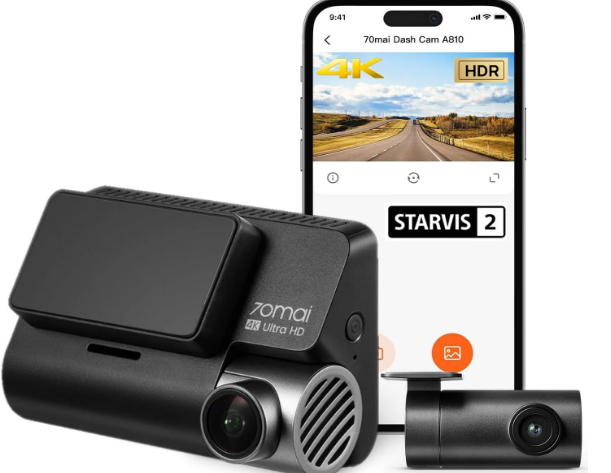
In this 70mai A810 Dashcam Review, we cover a dual channel dashcam built around the Sony STARVIS 2 IMX678 sensor, and it is one of the strongest options in the sub twenty thousand rupee segment for Indian buyers. It records true 4K on the front camera and 1080p HDR on the rear, includes a built-in GPS logger, ADAS alerts, and an optional parking mode with motion detection. After extensive testing across city traffic, highway drives, and night conditions, this camera holds up well against dashcams costing considerably more.
Table of Contents
- Quick Verdict
- Why You Need a Dashcam in India in 2026
- 70mai A810 Specifications
- Video Quality and Night Recording
- GPS, ADAS and Parking Mode
- 70mai App and Connectivity
- Installation and Build Quality
- Pros and Cons
- Price in India and Where to Buy
- Dashcam Buying Guide for India (2026)
- Frequently Asked Questions
- Final Verdict
70mai A810 Dashcam Review – Quick Verdict
The camera uses a 500mAh battery instead of a supercapacitor, which means it is less heat resistant during Indian summers when parked in direct sun for long hours. For most buyers looking for a daily driver dashcam with genuine night vision performance, the A810 remains a strong recommendation.
Why You Need a Dashcam in India in 2026
Indian roads present a unique mix of dense traffic, unpredictable lane changes, and a high volume of two wheelers sharing the same road space as cars and trucks. A dashcam is no longer a luxury accessory. It has become a practical tool for settling insurance disputes, providing evidence in hit and run cases, and protecting yourself from fraudulent accident claims. With traffic police in several states also beginning to accept dashcam footage as supporting evidence, having continuous, reliable video recording in the car has real, practical value.
Parking mode adds another layer of protection. Cars parked on Indian streets or in open society parking lots are frequently subject to minor scratches, hit and run dings, or attempted break ins. A camera that can detect motion or impact while the car is parked and switched off gives you a record of what happened, even when you were not around to see it.
70mai A810 Specifications
| Front Camera | True 4K UHD, Sony STARVIS 2 IMX678 sensor, 150 degree wide angle |
| Rear Camera | 1080p Full HD with HDR |
| GPS | Built-in GPS logger for speed and route tracking |
| ADAS | Forward collision warning and lane departure alerts |
| Parking Mode | Optional, with motion detection and time lapse recording |
| Storage | MicroSD card, supports up to 256GB, card sold separately |
| Connectivity | WiFi, controlled through the 70mai smartphone app |
| Power Backup | 500mAh built-in battery, not a supercapacitor |
| Box Contents | Front camera, rear camera, car charger, USB-C cable, mounting bracket, connecting cable, pry tool, user manual |
| Price in India | Approximately Rs 18,999 to Rs 20,999, MRP Rs 29,999 |
Video Quality and Night Recording
The headline feature of the A810 is its front sensor. Sony’s STARVIS 2 IMX678 is a 1/1.8 inch sensor, noticeably larger than what most dashcams in this price range use. In daylight conditions, footage from the front camera is sharp enough to read number plates from a reasonable following distance, and colours stay accurate even in harsh midday sun, which is common on Indian highways.
Where this sensor genuinely stands out is low light performance. Night drives on poorly lit Indian roads are where most budget dashcams fall apart, producing grainy, washed out footage that is useless for identifying number plates or faces. The A810 handles this noticeably better. Oncoming headlights do not blow out the frame as badly, and number plates remain legible in most streetlight conditions. It is not on par with dedicated night vision security cameras, but for a dashcam at this price, it is a genuine step up.
The rear camera, recording at 1080p, is respectable but expectedly a step down from the front unit. It is sufficient for capturing rear end collisions and reading plates of vehicles following closely, which covers the main use case for a rear channel.
GPS, ADAS and Parking Mode
The built-in GPS logger records speed and route data alongside the video, which is useful if you ever need to prove your speed or location at a specific time, for instance in an insurance dispute. It also means every clip is timestamped with location data automatically, without needing a separate accessory.
The ADAS features, forward collision warning and lane departure alerts, work reasonably well on highways at consistent speeds, but like most camera based ADAS systems in this price bracket, they can be inconsistent in dense city traffic where lane markings are faded or absent. Treat these as a helpful bonus rather than the main reason to buy this camera.
Parking mode is optional and needs to be enabled, along with either a hardwire kit or the camera’s internal battery for power while parked. With the 500mAh battery, the camera can only sustain parking mode monitoring for a limited window before power runs out, so buyers who want extended parking protection should budget separately for a hardwire kit that draws power directly from the car battery.
70mai App and Connectivity
The camera connects to the 70mai smartphone app over WiFi, which lets you preview live footage, download clips directly to your phone, adjust resolution and recording duration, and tune motion sensitivity for parking mode. The app also pushes a notification to your phone if the parking mode camera detects a collision or suspicious motion, and lets you check your car’s live location and route history when the car is being driven.
The app interface is functional rather than polished. Pairing is straightforward the first time, and clip downloads over WiFi are reasonably fast for short clips, though transferring longer 4K files can take a while given WiFi transfer speed limits. For most users, pulling the microSD card out and copying files directly to a laptop remains the faster route for reviewing longer footage.
Installation and Build Quality
Installation follows the standard dual camera dashcam process. The front unit mounts behind the rearview mirror using the supplied electrostatic sticker and bracket, and the rear camera mounts on the back windshield, connected via a cable that needs to be routed along the roof lining and down the door pillar. The included pry tool makes tucking the cable into the trim panels manageable without needing a mechanic, though budgeting thirty to forty five minutes for a clean, hidden cable run is realistic for a first time installer.
Build quality on both camera units feels solid for the price segment, with a compact front unit that does not obstruct much of the windshield view. The mounting bracket holds firmly once the electrostatic sticker has properly bonded, though it is worth waiting a few hours after installation before test driving, since the sticker needs time to set fully in Indian heat.
Pros and Cons
Pros
- True 4K front recording with excellent low light performance
- Built-in GPS logger with no extra accessory needed
- Dual channel setup covers both front and rear
- Supports up to 256GB storage for longer recording history
- Reasonably easy self installation with included pry tool
Cons
- 500mAh battery instead of a supercapacitor, less heat tolerant
- Extended parking mode needs a separate hardwire kit
- ADAS accuracy drops in dense, unmarked city traffic
- App file transfer over WiFi is slow for large 4K clips
- MicroSD card not included in the box
Price in India and Where to Buy
The 70mai A810 is listed at an MRP of Rs 29,999, but street pricing across Indian retailers typically ranges between Rs 18,999 and Rs 20,999, depending on ongoing sale events. Buying through Amazon India offers the added benefit of easy returns and warranty support tracked directly against your order, which is a meaningful advantage over unbranded marketplace sellers.
Dashcam Buying Guide for India (2026)
If the A810 is not the right fit, here is what to actually check before buying any dashcam in India.
1. Sensor Size, Not Just Resolution
Marketing specs love to highlight resolution, but sensor size determines low light performance far more than the megapixel count. A 4K camera with a small sensor will still struggle at night. Look for dashcams that mention a specific sensor model, such as the Sony STARVIS series, rather than just a resolution number.
2. Supercapacitor vs Battery
Dashcams left in a parked car under direct Indian sun regularly see cabin temperatures cross 60 degrees Celsius. Lithium batteries degrade faster under sustained heat, while supercapacitors handle heat far better and last longer over years of use. If parking mode and long term reliability matter to you, prioritise a supercapacitor model over a battery based one.
3. GPS and ADAS as a Bonus, Not the Main Feature
Built-in GPS is genuinely useful for timestamping and route logging. ADAS features on camera based systems are a nice bonus but should not be the deciding factor, since their accuracy varies significantly with Indian road markings and traffic density.
4. Memory Card Class and Capacity
Continuous 4K recording writes a large amount of data constantly, and a slow or low quality microSD card will eventually fail or corrupt footage. Use a card rated specifically for dashcam or continuous video use, ideally U3 or V30 rated, and avoid cheap unbranded cards even if the dashcam supports high capacity.
5. Installation and Cable Routing
Dual channel dashcams need a cable routed from the rear camera to the front unit, typically along the roof lining. Check whether the kit includes a pry tool and enough cable length for your car size, especially for SUVs and larger sedans, where the standard cable length supplied with budget kits sometimes falls short.
6. Legal Placement
Dashcams are legal to use in India, but the mounting position should not obstruct the driver’s forward view through the windshield, in line with general motor vehicle visibility rules. Mount the camera behind the rearview mirror, within the area typically cleared by the wiper blade, to stay compliant and avoid visibility issues.
For a wider comparison across different budgets, see our full best dashcams in India buying guide, which covers options below and above this price range.
For more background on how dashcam sensors and recording technology work, Wikipedia’s overview of dashcam technology and Sony’s own page on the STARVIS sensor lineup are useful references for understanding what drives night vision performance across brands.
70mai A810 Dashcam Review – Frequently Asked Questions
Is the 70mai A810 worth buying in 2026?
Yes, for buyers wanting strong 4K daytime and night recording under Rs 21,000, the A810 remains competitive against newer releases, largely due to its STARVIS 2 sensor performance.
Does the 70mai A810 need a separate memory card?
Yes, a microSD card is not included in the box and must be purchased separately. The camera supports up to 256GB.
Can I use parking mode without a hardwire kit?
The built-in 500mAh battery allows limited parking mode duration. For extended parking protection over several hours, a separate hardwire kit connected to the car battery is recommended.
Is dashcam footage accepted as evidence in India?
Dashcam footage is increasingly used as supporting evidence in insurance claims and by traffic authorities in several states, though acceptance can vary by jurisdiction and case.
Does installing the A810 require professional help?
Most users can self install it in under an hour using the included pry tool and mounting hardware, without needing a mechanic.
70mai A810 Dashcam Review – Final Verdict
The 70mai A810 earns its place as one of the better dual channel dashcams available in India today, primarily on the strength of its Sony STARVIS 2 sensor and genuinely usable night recording. The lack of a supercapacitor is a real trade-off for long term heat durability, but at its current street price, the core recording quality outweighs that limitation for most daily drivers. If your priority is sharp 4K footage with dependable night performance and built-in GPS, this is a safe recommendation.